
Exploring Gaussian Splats for Scan-to-BIM
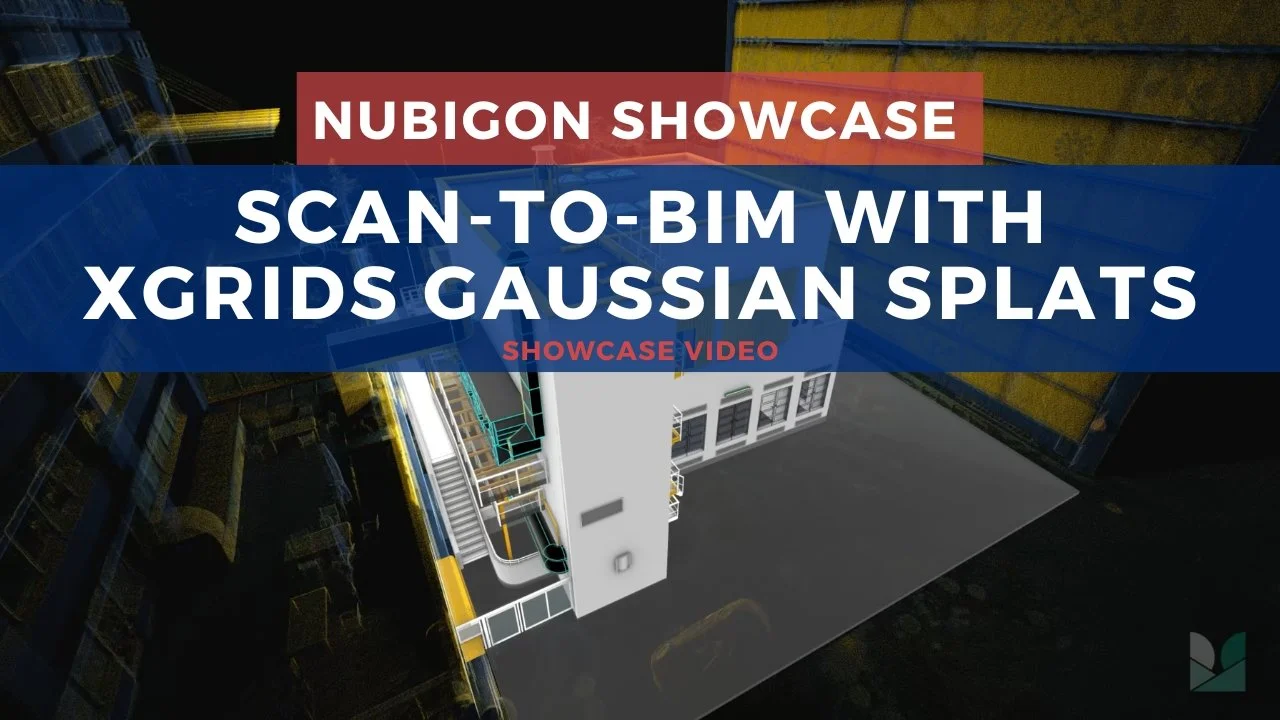
Captured & Modeled by Posch Preview. Video production by Reality Render Studio using NUBIGON
Anchoring BIM Models in Reality with XGRIDS and NUBIGON
Ever since we introduced support for Gaussian splat files with built-in level-of-detail rendering in NUBIGON, our users have been pushing toward increasingly ambitious 3DGS projects. What started with cinematic flythroughs and visually rich project showcases quickly raised the question:
How can Gaussian Splats be used for Scan-to-BIM?
At first glance, the answer is not entirely straightforward.
While Gaussian Splats can produce remarkably photorealistic representations of real-world environments, spatial accuracy remains a major challenge in many 3DGS workflows, at least for the time being. In many cases, Gaussian splatting pipelines are primarily optimized for visual realism rather than reliable geometric fidelity across large or complex built environments.
For Scan-to-BIM workflows, however, spatial accuracy is foundational. Modeling existing conditions requires dependable geometric reference data, especially when BIM deliverables are used for design coordination, renovation planning, facility management, or digital twin initiatives. This is where the XGRIDS platform introduces a particularly compelling approach.
Unlike many standalone Gaussian Splat workflows, XGRIDS jointly produces SLAM-based point clouds alongside photorealistic Gaussian Splats. Instead of choosing between spatial structure and visual realism, you get both from the same capture workflow. That combination opens up a very interesting direction for Scan-to-BIM.
Point Clouds for Modeling. Gaussian Splats for Context.
In practice, point clouds remain the primary geometric reference for modeling workflows. They provide: dependable spatial structure, measurable geometry, and the precision needed for BIM authoring. Gaussian Splats, meanwhile, introduce a second layer: a highly photorealistic contextual representation of the site. This becomes valuable in several ways.
During modeling and QA/QC, splats can help teams visually verify that modeled assets accurately reflect real-world conditions. Surface continuity, material transitions, clutter, furniture, vegetation, lighting conditions, and spatial relationships often read far more intuitively in 3DGS than in raw point clouds alone. For many stakeholders, this dramatically lowers the interpretation barrier.
A non-technical stakeholder may struggle to interpret a dense point cloud, but immediately understand a Gaussian Splat reconstruction because it more closely resembles how humans perceive real environments.
As a result, Gaussian Splats can act as:
A visual validation layer during modeling
A communication layer during coordination
A presentation layer for final deliverables
Anchoring BIM Models in Reality
One of the most compelling aspects of hybrid Scan-to-BIM presentations is the ability to jointly display:
Point clouds
BIM models
Gaussian Splats
…within the same environment.
When done correctly, this creates a much stronger understanding of how well the final BIM deliverable is anchored in real-world conditions. The BIM model no longer exists in isolation. Instead, stakeholders can directly evaluate:
How closely the model matches reality
What was modeled
What remains contextual
How design intent relates to existing conditions
How complete and trustworthy the deliverable is
This hybrid representation is especially powerful for client presentations, design reviews, executive communication, and digital twin initiatives.
But making this work reliably requires two critical capabilities:
Reliable alignment between all assets
Seamless rendering of all asset types together
Alignment Through Shared Spatial References
Alignment is often one of the biggest challenges in hybrid visualization workflows.
NUBIGON addresses this with auto-alignment for Revit RVT models and linked RCP/RCS point clouds. Since the XGRIDS workflow jointly produces both point clouds and Gaussian Splats, the point cloud effectively serves as the shared spatial reference for all assets.
This creates a highly practical workflow:
The point cloud anchors the scene spatially
The BIM model aligns automatically through the linked scan references
The Gaussian Splats inherit the same real-world context
The result is a seamless hybrid scene in which all representations of the site reinforce one another rather than compete for alignment.
Rendering Large Hybrid Scan-to-BIM Scenes
Scan-to-BIM visualization introduces rendering demands different from those of purely cinematic workflows.
For modeling and validation purposes, teams often require:
More complete coverage
Denser reconstructions
Higher retained detail
Broader site context
Longer capture sequences
As a result, even Gaussian Splat datasets can become exceedingly large.
This is where NUBIGON’s built-in level-of-detail rendering becomes especially important.
Instead of treating Gaussian Splats as lightweight showcase assets only, NUBIGON was designed to handle increasingly ambitious hybrid scenes containing:
large point clouds
BIM models
Meshes
Gaussian Splats
…all within the same environment.
On top of that, NUBIGON includes dedicated rendering and presentation workflows specifically designed for Scan-to-BIM communication, enabling teams to produce guided presentations that clearly demonstrate how digital deliverables relate to real-world conditions.
A New Layer for Scan-to-BIM Communication
Gaussian Splats are not replacing point clouds. And they are not replacing BIM. But they are introducing a powerful new visual layer between the two.
Point clouds continue to provide the geometric foundation required for accurate modeling. BIM models continue to deliver structured, actionable results.
Gaussian Splats help bridge the gap between them by making existing conditions easier to interpret, validate, and communicate.
The result is a more accessible and visually coherent Scan-to-BIM workflow, one in which models no longer float abstractly, but remain visibly anchored in reality.